
I didn’t see it this time.
Colorado was too far away from the “path of totality” for even a hint of a glimpse of yesterday’s total solar eclipse.
But we did get to experience this eerie natural phenomenon in 2017 when the blacked-out sun was directly overhead in St. Joseph, Missouri, a short one-hour drive north from our then home in Overland Park, Kansas.
To be more accurate, I should say we “sort of” experienced it.
In the photos I have attached here you will see the cloud-obscured view we had of the moment of totality as well as my eclipse dramatization with the aid of an Oreo cookie and the can light in my friend’s kitchen.
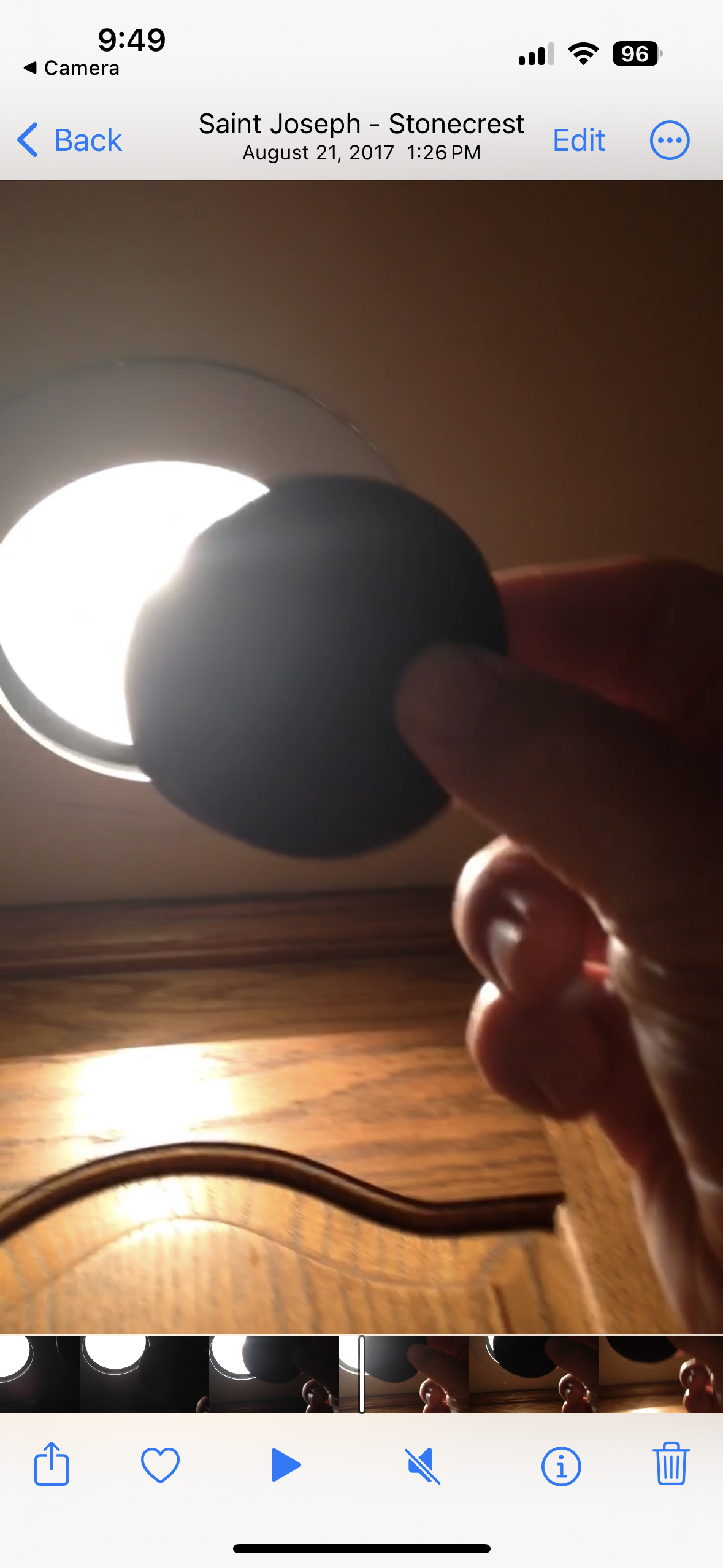
In contrast to my 2017 eclipse experience, I have heard many reports of people gushing and effusing about yesterday’s four minutes of mid-day darkness. One news commentator called it, “emotionally overwhelming.”Another could not contain her screams of delight at the moment the moon perfectly and exactly covered over the sun (see aforementioned dramatization).
You might have seen so much news coverage of the eclipse that you are tempted to stifle a yawn and mutter, “Yeah, yeah… whatever. What I really want to know is who won the men’s college basketball championship?”
UConn, by the way.
But take a minute and mull over these facts; the distance from the earth to our moon is 238,900 miles, while the sun is a whopping 93 million miles away. The diameter of the moon is 2,159 miles (at last measurement) while the sun is 865,370 miles around its equator.
AND YET… at the moment of totality in a solar eclipse, our moon appears to EXACTLY cover and completely block out the sun.
Exactly. Precisely. Perfectly.
How is that even possible? It is an absolute miracle of cosmic artistry in action. You might even call it “divine design” if you were so inclined.
So, if I am still around in 21 years, they tell me I have another chance to see a total solar eclipse here in the U.S. Or I can travel to Greenland, Iceland, Spain, Russia, or a small area of Portugal on August 12, 2026, if I don’t want to wait until 2044.
But why wait even one more day to be “emotionally overwhelmed” by the genius of design in the world around us? I will just go ahead and be bold enough to suggest that this wonder… this awe… this beauty is something that lurks around every corner we turn every moment of every day.
Take – for example – the Fibonacci Sequence. Also known as the “Golden Ratio,” (or 1.618 to you and me) it is a ratio that applies to the number of petals on a flower, the spirals in the heart of a seed-bearing plant or a seashell, and the length of your lower leg to your entire leg. Or of the length of your whole finger to the length of your finger up to the first knuckle.
Or take the miracle, awe, and wonder of the human body’s self-healing ability. Or the eye’s ability to discern millions of different shades of color. Or consider if you will the constancy of the ocean’s level of salinity despite constant evaporation and rainwater runoff.
Often, like the fish who is unaware of the water it swims in every day, our senses too often are dulled to the sheer miraculousness of our lives and the world.
The Psalmist, who might have just finished witnessing a total solar eclipse, waxed rhapsodic when they wrote, “When I look at your heavens, the work of your fingers, the moon and the stars that you have established; what are humans that you are mindful of them, mortals that you care for them?” (Psalm 8:3-4, NRSVU).
I don’t know. I might just start looking into booking a trip in August 2026 to one of those places where I can see the next total solar eclipse up close and personal.
OR I might just practice opening my eyes to the awe and wonder right here in front of me every day.
Abundant blessings;


 Russellings of the Spirit
Leave a reply to revruss1220 Cancel reply